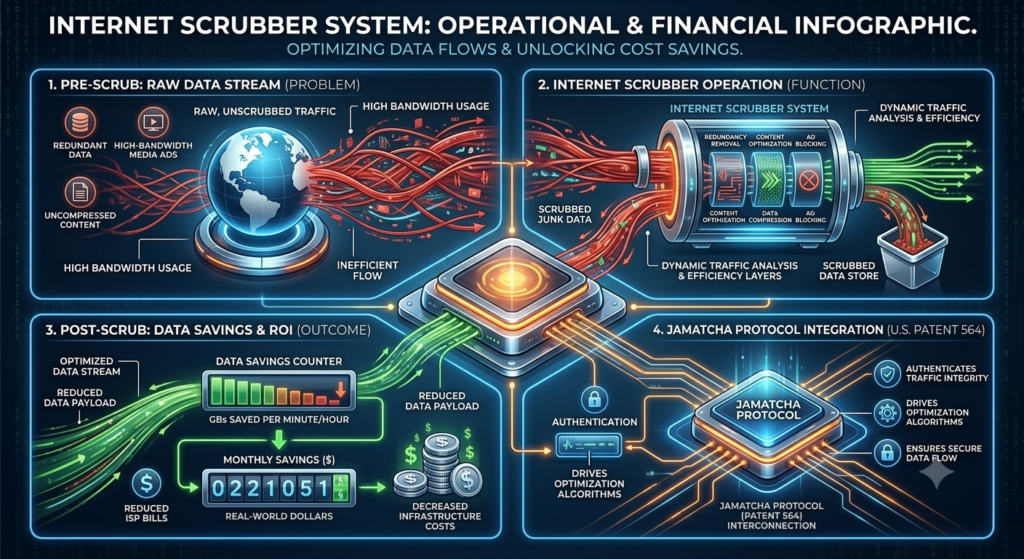
The Internet Scrubber: Eliminating “Digital Permafrost” and CapEx Bloat
The Internet Scrubber is a revolutionary data optimization architecture designed to resolve the global “dark data” crisis. Current data trends indicate that up to 80% of stored electronic data goes unaccessed for years, creating massive archives of stale, duplicate files referred to as “Digital Permafrost”. Instead of relying on traditional, “blind” deduplication that fails when users alter metadata, the Internet Scrubber utilizes an AI-driven “Medicinal Scrub” protocol. By recognizing the fundamental structural binary of content via Semantic DNA fingerprinting, this system surgically sanitizes high-energy servers—drastically reducing the physical hardware footprint, power consumption, and unmanaged carbon emissions of modern cloud computing infrastructure.
Core Technological Capabilities:
- Semantic DNA Fingerprinting: The system bypasses superficial metadata (like a renamed file attachment) and analyzes the core structural binary of the content. Upon identifying a Semantic Duplicate, it permanently purges the physical duplicate payload from the high-energy local server drive.
- The “Ghost Pointer” & Zero-Knowledge Privacy: The purged multi-megabyte payload is replaced in the user’s local directory by a 1-KB cryptographic “Ghost Pointer”. Operating as a Zero-Knowledge Decentralized Access Pointer (ZK-DAP), the central server cannot read the data. If a user clicks the pointer, a secure stream is routed from a master asset, requiring the user’s private cryptographic key for local decryption and re-inflation, ensuring total privacy.
- CapEx Avoidance & Financial ROI: By reclaiming vast percentages of physical server space instantly, the system negates the enterprise requirement to construct new, billion-dollar data facilities. The protocol automatically generates an “Infrastructure CapEx Avoidance Report” detailing the exact dollar amount saved and calculates the Total Energy Reduction (TER) to mint verified Carbon-Reclamation Credits for corporate compliance.
- The Circular Hardware Economy: As the system liberates physical server space, it automatically migrates remaining active data to the most efficient drives and systematically decommissions older, functional server racks. The central system generates an automated manifest to package this dormant hardware as high-capacity educational micro-servers, turning corporate e-waste into a humanitarian deployment strategy for developing nations.