Spatial Computing & Co-Pilot
Title: Spatial Computing & Synchronized Simulation
The Co-Pilot System
Co-Pilot bridges the gap between physical transit and augmented reality. This passenger-operated AR driving simulation synchronizes directly with a vehicle’s real-time telemetry, offering gamified skill acquisition based on actual vehicular movement. It is fully integrated with the APE-X tokenization ecosystem.
VR Flyer & Specialized Simulation
Serving as the core spatial computing platform, VR Flyer houses the expanded claims for our augmented and virtual reality technologies. This foundation also powers our specialized Luge Training Tech, designed to provide high-fidelity, high-speed simulation environments for elite athletic training.
Digital Infrastructure & Core Ecosystem
Micro-Mobility, Energy & Safety
Wearables & Spatial Computing & SIDOG (Social Interaction During Online Games) – Sidogger’s do it live in real-time!
SIDOG VR Flyer Web Page Headliners
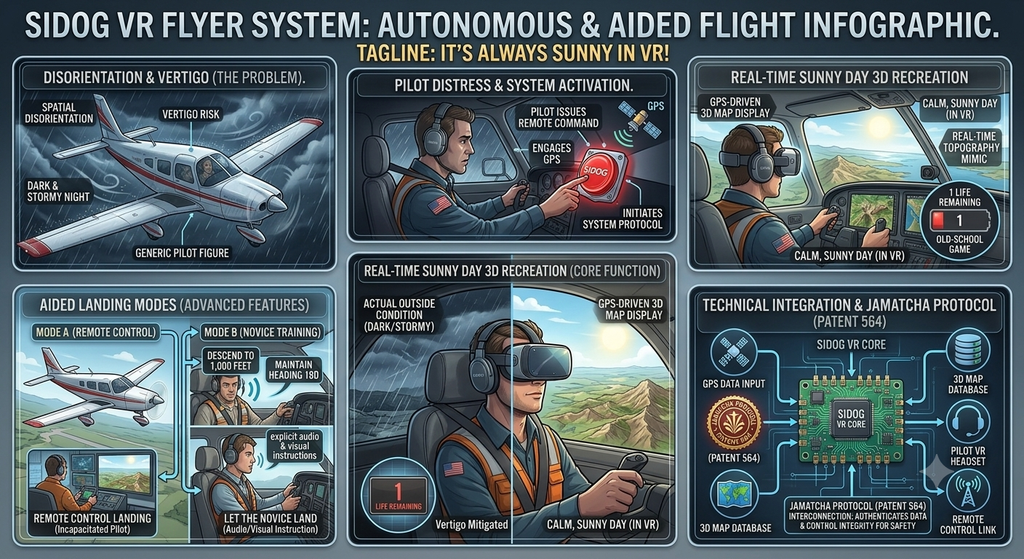
- SIDOG VR Flyer: It’s Always Sunny in VR!
- Navigate the Storm: Real-Time Topographical Clarity for High-Stakes Flight.
- The “Light Saver” Protocol: Turning Zero-Visibility Danger into Clear-Sky Confidence.
Provisional Patent Coverage
The SIDOG VR Flyer technology, including its specific aviation applications, is covered under our provisional patent application titled: “Fractional-Projection Architecture for Real-Time Kinematic Synchronization, Spatial Venue Emulation, and Verified Digital Asset Injection”.
How the VR Flyer Operates
- The “Light Saver” Augmented Vision Overlay: During severe environmental occlusion, such as flying on a dark and stormy night, the system intercepts live non-entertainment telemetry, including GPS, altitude, and velocity. It then generates a real-time, daylight-equivalent 3D topographical map and projects it directly onto a pilot’s head-mounted VR display.
- Vertigo Mitigation & Aided Landing: By providing a stable, clear-sky visual reference, the system actively mitigates the risk of spatial disorientation and vertigo. In emergency situations, the system supports remote control landing protocols for incapacitated pilots or provides explicit audio and visual instructions to help a novice passenger land the aircraft safely.
- Institutional Emulation (Zero-Risk Training): The architecture allows secondary users, such as student pilots, to intercept this live flight data in a virtual sandbox. They can act as real-time responders, safely practicing emergency resolutions using actual incoming telemetry without any real-world risk to lives or equipment.
- Security & Integration: The SIDOG VR Core is secured by the Jamatcha Protocol (Patent 564), which authenticates the data integrity and remote control links to ensure the absolute safety of the aircraft’s systems.