Safety First! –
The “Auto-Righting” Buoyancy Mechanic
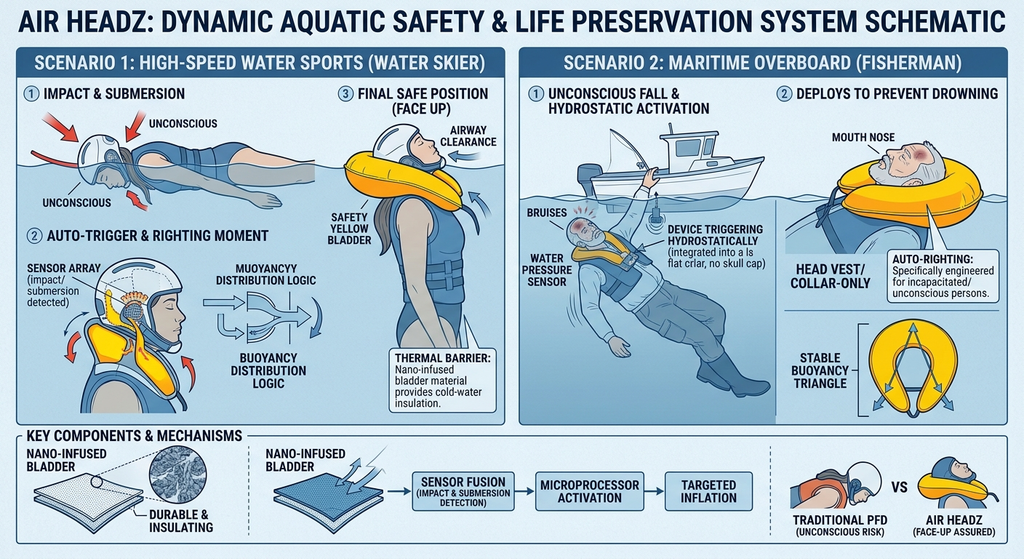
For water sports and aviation, the core value proposition is keeping an unconscious person alive.
- Asymmetrical Volume Distribution: The air chambers can be designed to inflate with more volume at the front of the chest/neck and less at the back. This creates an automatic “righting moment,” physically forcing an unconscious user to roll face-up in the water.
- Hydrostatic vs. Impact Triggering: For high-speed sports (Jet Skiing), the system triggers on impact. For aviation or fishing, it could utilize a hydrostatic valve that triggers the inflation chambers the moment it is submerged in water, alongside a manual pull-tab.
- The Thermal Barrier: Trapped air is a highly effective insulator. The chambers will dramatically slow the loss of core body heat through the neck and head, extending survival time in cold water.
Design Variations: Full Cap vs. Collar-Only
Offering two form factors allows you to capture vastly different industries.
- The Full Cap Model: Essential for high-velocity water sports (wakeboarding, kite surfing). It provides the dynamic impact protection needed when hitting the water at 60mph, and then immediately transitions into a flotation and thermal survival device.
- The Collar-Only Model: This is your aviation and casual marine product. It stows completely flat around the neck. During a plane crash, it deploys to brace the neck against whiplash or blunt force, and then acts as the ultimate life vest if the cabin breaches water.
Air Headz: The Pneumatic Safety & Smart-Camera Ecosystem
The Air Headz ecosystem completely redefines cold-weather protective gear, transforming traditional winter apparel into a highly advanced, tech-enabled safety and performance platform. Discarding uncomfortable rigid alpine helmets that cause overheating and lens fogging, Air Headz utilizes an active pneumatic soft-crash matrix combined with a fluidically suspended digital mesh-network node to bridge the gap between physical thermal dynamics, mechanical impact protection, and autonomous telemetry.
Core Technological Capabilities
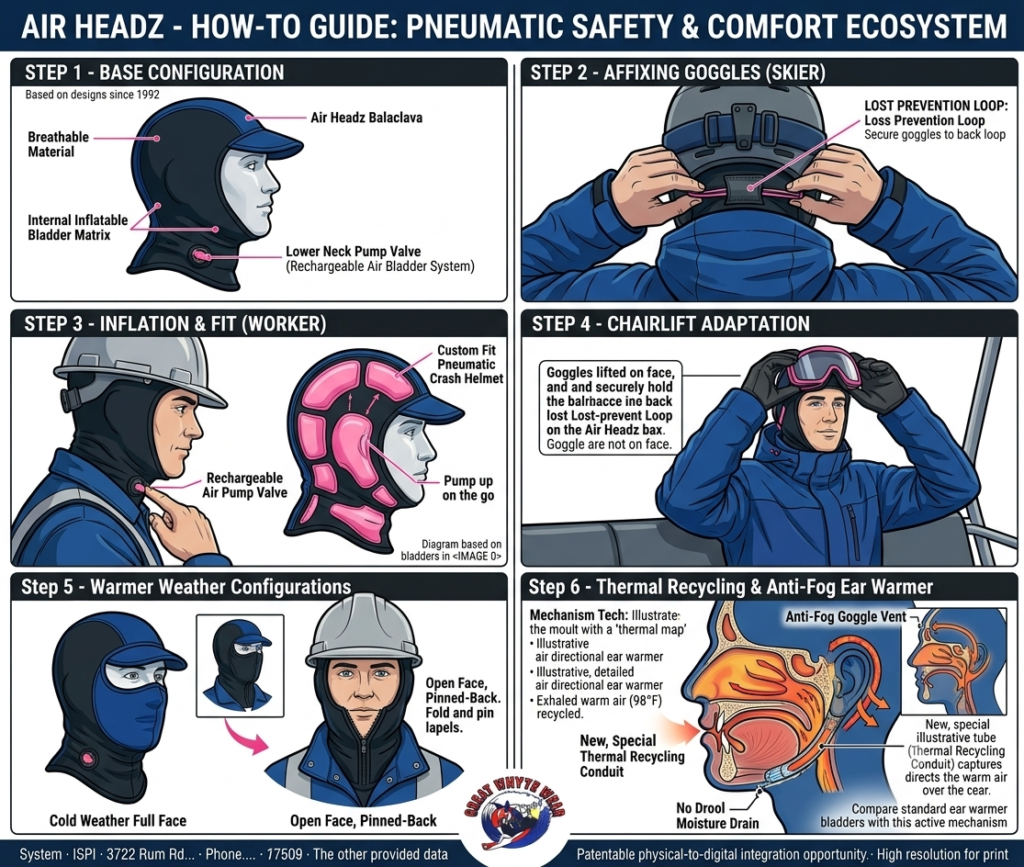
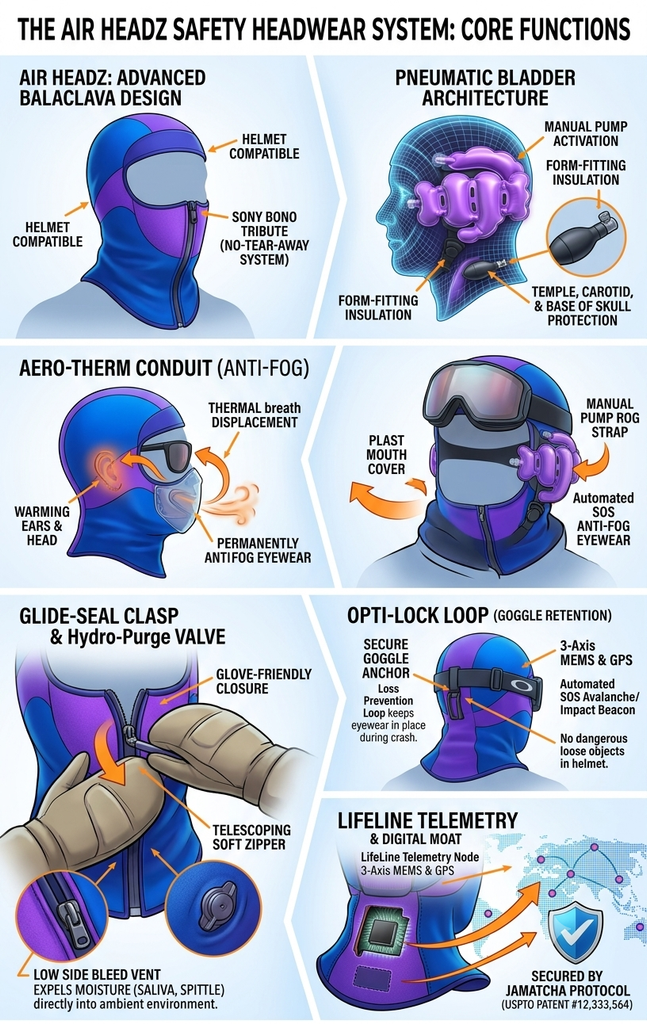
- Pneumatic Impact Attenuation & Custom Fit: The headgear features a rechargeable, form-fitting pneumatic bladder architecture that allows users to manually pump and sculpt the helmet to their specific cranial contours. This provides superior thermal insulation and soft-crash impact protection for highly vulnerable areas—including the temples, carotid artery, and base of the skull—without relying on dangerous tear-away mechanisms. An integrated Opti-Lock loop securely anchors eyewear to the back of the head to prevent detachment during a crash.
- Aero-Therm & Hydro-Purge Climate Control: An engineered internal ventilation architecture actively captures latent body heat and exhaled breath. The Aero-Therm conduit redirects this warm air across the eyewear interface to permanently eliminate lens fogging while simultaneously channeling warmth to the ear canals to prevent frostbite. Concurrently, the Hydro-Purge lower facial vent gravity-drains excess moisture, mucus, and saliva directly into the ambient environment, keeping the interior dry and preventing skin freezing.
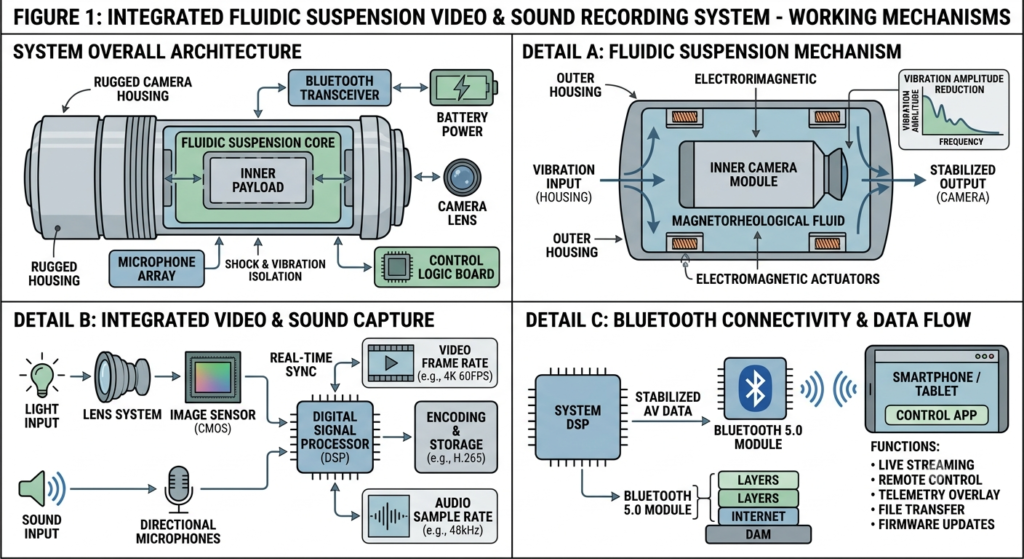
- Fluidic Camera Suspension & Solar Charging: A hermetically sealed inner digital camera payload floats within an outer housing filled with a photo-sensitive, magnetorheological fluid. This viscous suspension acts as a multi-axis kinetic dampener to eliminate video shake during high-speed action. Furthermore, the fluid is infused with silver nitrate or colloidal nanoparticles, enabling the device to be solar-charged, light-charged, or powered via contactless charging hubs without requiring exposed ports.
- Rear-Guard Threat Detection & LifeLine SOS: Powered by a localized Digital Signal Processor (DSP), the floating payload utilizes rear-facing optical sensors to run a threat-detection algorithm that recognizes rapidly approaching objects, instantly triggering a localized haptic or audible alert upon a proximity breach. If a kinetic impact breaches predefined safety thresholds, the Jamatcha-secured LifeLine telemetry node automatically locks the captured video files and broadcasts an authenticated SOS geolocation beacon directly to the peer-to-peer mesh network.
Air Headz: The Smart Survival Ecosystem
The Air Headz architecture completely reimagines protective headgear by replacing traditional rigid helmets with a customizable, pneumatic “soft-crash” bladder matrix. This form-fitting inflatable layer actively cushions blunt-force trauma while delivering a modular platform for extreme weather survival and digital telemetry.
Active Comfort & Utility Mechanics
The physical design operates as a foundation for both extreme element protection and modular hardware integration:
- Aero-Therm Ear Warmer: An internal conduit actively captures exhaled breath and routes it across the ear canals for warmth, while simultaneously deflecting it away from the eyewear boundary to permanently eliminate lens fogging.
- Opti-Lock Eyewear Strap: A quick-release anchor loop secured to the rear exterior wall prevents expensive goggles and sunglasses from being ripped away and lost during high-speed impacts.
- Acoustic & Speaker Pockets: The balaclava design seamlessly accommodates built-in ear pockets for speakers, allowing the wearer to comfortably insert audio devices directly into the soft housing without creating dangerous pressure points.
Smart Camera & LifeLine Security
The headgear transcends passive protection by integrating a fluidically stabilized smart camera and the LifeLine emergency network:
- Threat-Detection Camera: A digital camera payload is suspended in magnetorheological fluid to eliminate vibration and shake, while utilizing rear-facing optical sensors to act as an active, rear-guard human dashcam. A digital signal processor tracks fast-approaching objects to trigger automated alerts through the integrated audio headset.
- LifeLine Telemetry: Embedded within the skull cap structure is a localized mesh-network node containing a multi-axis MEMS accelerometer. Upon a violent impact, the node automatically broadcasts an encrypted SOS geolocation beacon to first responders and nearby peer nodes.
Jamatcha Protocol & APE-X.ai Integration
This hardware ecosystem is legally bound to the overarching APE-X.ai architecture governed by USPTO Patent #12,333,564. Before transmitting any SOS or threat alert, the Jamatcha Protocol executes a cryptographic biometric handshake to verify that the alert originates from a living human, eliminating automated bot spoofing, false positives, and malicious data injection. Furthermore, as the fluidic system generates power through physical movement, this authenticated telemetry is fed into the remote APE-X.ai server to distribute interactive, gamified digital rewards directly to the user’s digital wallet.