Cycl-Opts: Macro-Scale Optical & Environmental Harvester
Cycl-Opts is a macro-scale compound environmental energy generator designed to harvest solar, wind, geo-thermal, and oceanic wave energy. Operating as the utility-scale backbone of the fluidic architecture, it replaces fragile and inefficient traditional solar arrays with a multi-modal, adaptive ecosystem.
Dual-Stage Concentration & Secondary Power
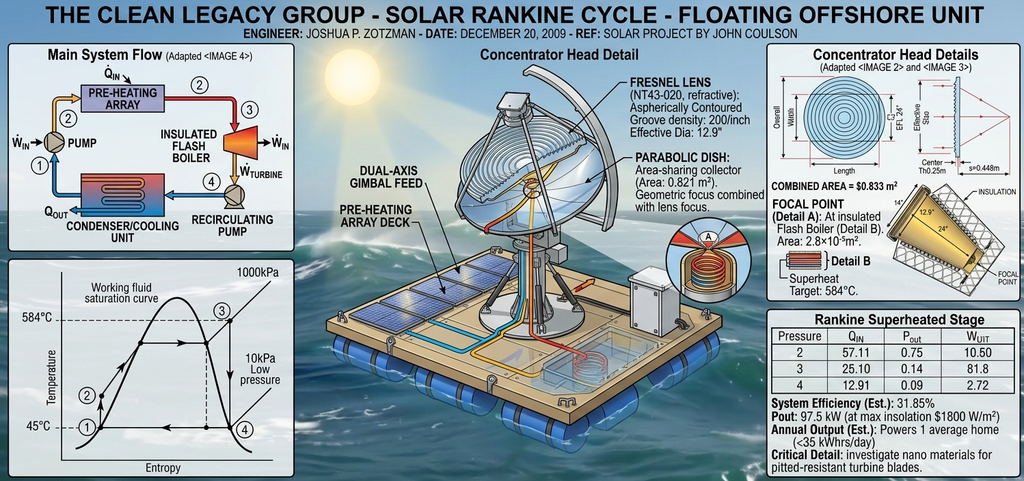
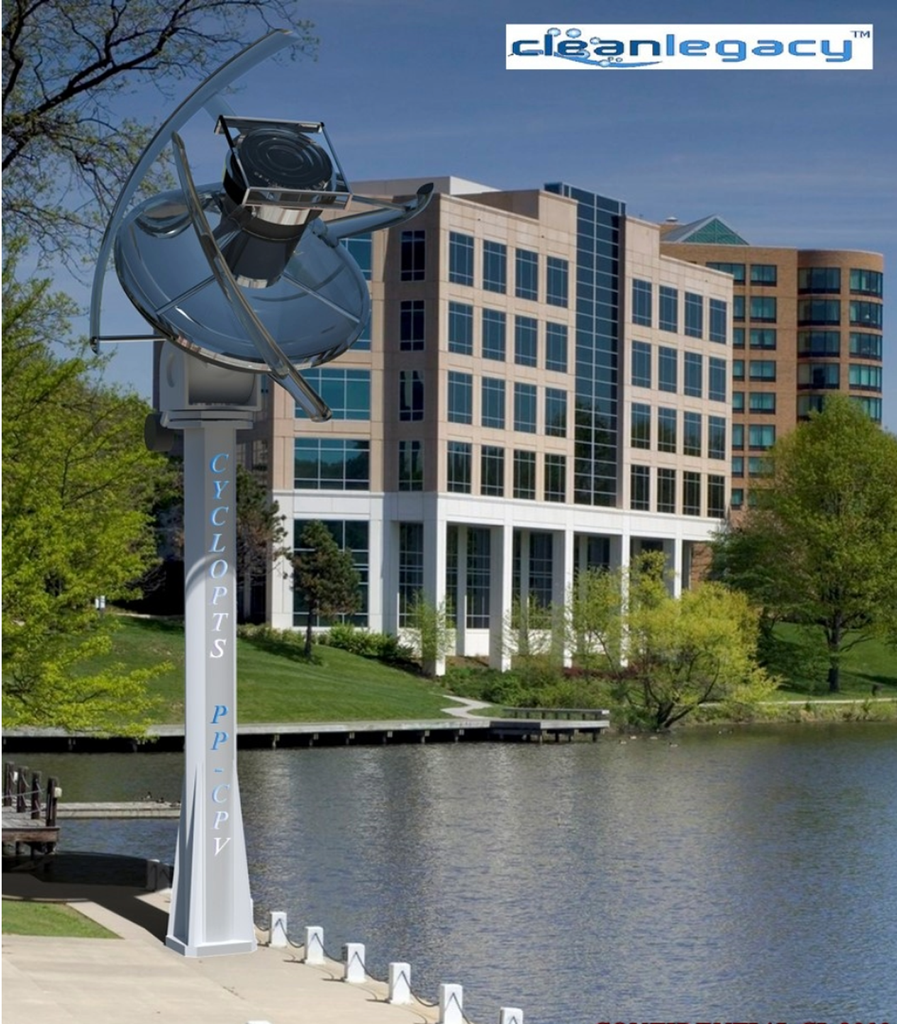
The system is built around a dual-stage optical concentrator that combines a primary parabolic dish with a secondary point-focusing Fresnel lens.
- Anti-Glare Mirrored Housing: To eliminate the aviation hazards and “microwave oven” effects of standard solar arrays, the optical concentrator is sealed within a main housing capped with a convex, half-silvered mirrored material. This allows sunlight to enter but traps concentrated thermal and light energy from reflecting back into the atmosphere.
- Wavelength Routing: A prism array splits the concentrated solar radiation into isolated wavelengths. A fiber-optic cable network then channels this targeted light for natural interior illumination, ultraviolet water purification, or infrared space heating.
- MagLev Turbine: Affixed to the exterior is a magnetically levitated turbine fan. Propelled by both ambient wind and internal exhaust heat, it generates supplementary electrical power while acting as a physical weather shield.
- Offshore “Sea Bags”: In marine deployments, Cycl-Opts utilizes a flexible polymeric bladder anchored in the ocean. This configuration harnesses violent wave agitation and extreme thermal gradients against the cold water to generate utility-scale Seebeck electrical power.
4-Tiered Adaptive Optical Stabilization
To maintain absolute focal precision for the optical concentrator despite volatile wind or kinetic environments, the apparatus relies on a four-tiered active correction matrix:
- Tier 1 (Mechanical Gyroscope): A 3-axis mechanical gimbal provides base-level coarse alignment.
- Tier 2 (Fluidic Micro-Dampener): The primary optical concentrator is dynamically suspended in magnetorheological fluid, utilizing DSP-modulated induction coils to instantly neutralize high-frequency micro-vibrations.
- Tier 3 (Active Optical Shift): A secondary corrective lens is mounted to high-speed piezoelectric micro-actuators that actively shift across an X-Y plane to re-center converging light beams in real time.
- Tier 4 (Electrochromic Spatial Masking): An electrochromic polymer matrix on the primary lens dynamically alters localized opacity to create digital “shadows” that mathematically steer the focal point.
Jamatcha, APE-X.ai, & LifeLine Integration
The physical generation of power is inextricably tied to the overarching digital architecture governed by USPTO Patent #12,333,564.
- Jamatcha Protocol: An integrated digital signal processor (DSP) manages the harvested energy and executes the localized Jamatcha cryptographic verification protocol. This ensures the origin and integrity of all telemetry data, preventing automated bot spoofing or malicious network tampering at the grid level.
- APE-X.ai Gamification: Once authenticated by Jamatcha, the telemetry is fed into the remote APE-X.ai artificial intelligence server. The network calculates the volume of electrical energy harvested and distributes interactive, gamified digital rewards and micro-transactions to the associated enterprise or user profiles.
- LifeLine Emergency Telemetry: As a foundational pillar of the broader hardware ecosystem, Cycl-Opts is specifically configured to interface with and power the LifeLine network. In remote or offshore marine applications—where autonomous surface buoys use geofencing logic to navigate—these macro-installations act as highly powered relay stations, supporting real-time SOS geolocation, multi-axis impact detection, and automated first-responder notifications for users equipped with micro-scale LifeLine gear.