Advanced Communications & Smart Materials
Programmable Smart-Glass: The Future of Sustainable, Dynamic Displays
Programmable Glass represents an advanced smart-material integration designed to turn standard transparent surfaces into interactive digital displays. By embedding programmable elements directly into the glass substrate, this technology allows everyday windows or vehicle windshields to function as dynamic visual interfaces, perfectly complementing the Co-Pilot AR system and the broader APE-X advertising network.
The Programmable Smart-Glass system represents a revolutionary shift in advanced materials, engineered to replace toxic, cellulose-based commercial printing, packaging, and static advertising. Serving as a dynamic physical substrate driven by the proprietary “Sublimaview” pixel-scrambling architecture, this technology transforms ordinary transparent mediums—such as architectural glass and mouldable polymers—into secure, infinitely reusable messaging platforms.
Core Technological Capabilities:
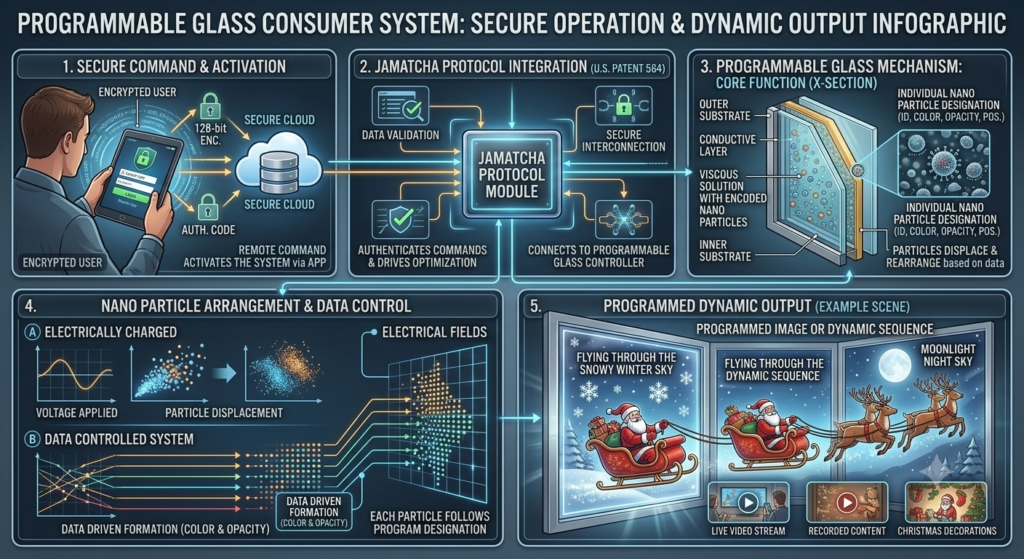
- Nanoparticle Engineering & Bistable Efficiency: The consumer-packaging embodiment utilizes photo-luminescent magnetic nanoparticles suspended within a highly viscous, transparent fluid matrix. By applying precise data-driven electrical and magnetic fields, these particles are displaced and rearranged into high-resolution imagery or dynamic sequences. Because of the fluid’s viscosity, the system achieves a “bistable state”—meaning it requires absolutely zero electrical power to maintain an image indefinitely once it has been formed.
- Secure Command & Validation: To prevent malicious reprogramming or visual hijacking of public displays, the command architecture is protected by enterprise-grade cryptographic handshakes. Cloud-based remote activation flows directly through the Jamatcha Protocol module, which authenticates data and drives optimization before executing any physical pixel reassignment.
- Ubiquitous Structural Deployment: Designed for both fixed-pixel architectural installations and mouldable commercial packaging, the system can seamlessly replace static automotive wraps, update retail point-of-sale displays in real-time, or eliminate single-use container labels entirely. In aerospace applications, the glass can even be programmed to simulate high-definition, soothing environmental views for passengers during turbulent or night-time flights.
- Optical Multiplexing & AR/XR Integration: The display engine is capable of interleaving multiple discrete visual data streams within the same physical pane of glass. It can display a primary macroscopic image (like a holiday sequence) visible to the naked eye, while simultaneously projecting a secondary, frequency-shifted, or polarized scrambled image that can only be descrambled and viewed by users equipped with synchronized AR/XR eyewear.